


Corporate Social Responsibility
Our Commitment to Sustainability
At Engage Management Hospitality, corporate social responsibility is an essential part of our identity.
We promote hospitality that respects the planet, people, and local communities through initiatives that create value for our teams, clients, and societies. We know that change takes time, but we move forward with determination and commitment.
Our CSR strategy is structured around 3 essential pillars that guide our impact.
By integrating them into all our operations, we ensure the creation of sustainable value and reinforce our commitment to responsible hospitality.

1. Acting with
Corporate Responsibility
At Engage Management Hospitality, we believe that a more responsible future begins with the decisions we make every day. That is why CSR lies at the heart of everything we do. To carry out our environmental ambition, we rely on the central Accor team, which guides and supports us at every stage of the journey. In the field, our “Green Teams” mobilize our hotels, restaurants, and wellness centers.
It is a collective, sincere, and committed effort — driven by everyone and for everyone.
- We set high standards of governance while building strong relationships with our investors.
- We ensure regulatory compliance and promote ethical and transparent conduct in all our operations: we are committed to integrity, legal compliance, and the highest ethical standards.
- Our Code of Ethics, along with policies such as the Anti-Corruption Code and the Gifts Policy, establishes a clear framework for responsible conduct.
- We invest responsibly, incorporating CSR criteria into every investment decision.
- We manage our supply chain by reducing CSR risks and promoting good practices throughout the value chain: we require our suppliers to comply with laws on human rights, labor, safety, environment, and business ethics. With rigorous procurement processes and strong governance, we ensure compliance and continuous improvement in CSR.

2. Respecting
people and the environment
At EMH, social responsibility begins with caring for those who make our activity possible: our employees.
We are committed to offering quality working conditions and attractive career paths, which allow us to retain talent in each of our establishments.
- We promote a diverse, inclusive, and safe work environment, where talent can thrive, well-being is a priority, and CSR culture is fully integrated.
- We drive climate action by reducing our carbon footprint, adapting to climate change, promoting circular economy practices, and protecting biodiversity.

Our Direction: Toward Low-Carbon Hospitality
Carbon Reduction
In 2024, our goals are being validated by the Science Based Targets initiative (SBTi). Our strategy is structured around three key pillars:
- Training our teams
- Improving the energy efficiency of our buildings
- Increasing the use of renewable energies and decarbonizing our supply chain
These pillars allow us to promote a more sustainable, low-emission hospitality model.
Our Climate Commitment: to reduce Scope 1 and 2 emissions by 50%, and Scope 3 emissions by 28% by 2030, using 2019 as the base year.
Environmental Certifications
To ensure high environmental performance, we work to obtain Breeam-in-use certification for our upcoming constructions.
Likewise, 100% of our hotels are certified with the Green Key label. This international eco-label recognizes excellence in sustainability across 13 key areas. More than just a certification, Green Key drives continuous improvement, motivating our teams to innovate and strengthen their positive CSR impact year after year.

3. Commitment to the community
and the environment
We elevate the sustainable guest experience through care, comfort, innovation, and accessibility.
We believe that the guest experience should be both exceptional and sustainable. Our Sustainable Experience Policy ensures comfort, accessibility, well-being, and responsible gastronomy.
With the support of the Green Key certification, we promote continuous improvements and top-tier environmental and social standards.
In this way, we integrate sustainability into every stay and build a more responsible hotel experience.
We generate social impact through local employment, community involvement, and the creation of versatile hotel spaces that add value to both guests and neighboring communities.
EMH hospitality extends beyond our hotels.
We support local employment, promote community projects, and design versatile spaces that generate positive impact.
Our teams actively participate in volunteering and local collaborations, strengthening social ties. Through innovative initiatives, our hotels drive sustainable change and contribute to stronger, more inclusive communities.
MAIN Actions
Energy and Water Efficiency
Through sustainable technologies and customer awareness.
Our new constructions carry the Breeam seal, an international certification that evaluates the environmental sustainability of buildings and construction projects. They are designed and built considering criteria that reduce environmental impact, improve energy efficiency, and enhance the well-being of the people who use them. In addition, we have eliminated the use of gas by replacing gas boilers with aerothermal systems.Además, eliminamos el uso de gas sustituyendo calderas de gas por aerotermia.
Reduction of Plastics
and Single-Use Products
We replace these products with more sustainable and less polluting alternatives, such as water fountains, reusable cups, and refillable dispensers, and we have eliminated all individual breakfast products in favor of bulk items that avoid plastic packaging.
Repair and Reuse
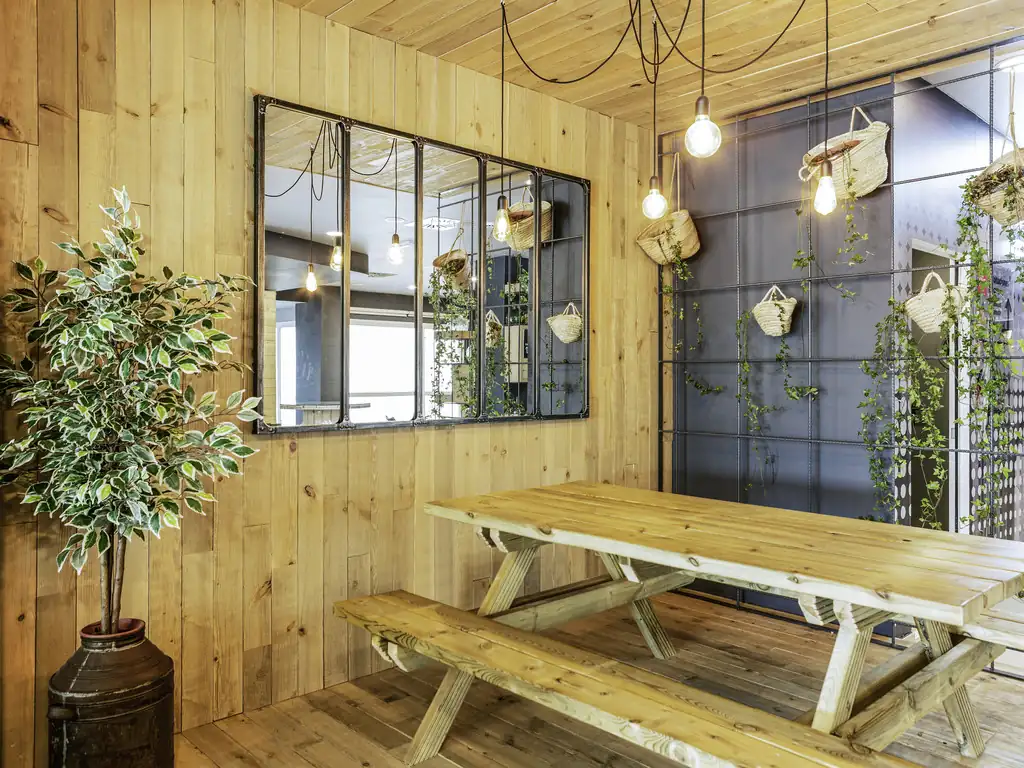
Promoting a circular economy and local collaborations. All the furniture in our new Greet Alicante hotel comes from reused materials.
Future Outlook
We measure our carbon footprint with the intention of reducing it progressively.
Our goal: to reduce Scope 1 and 2 emissions by 50%, and Scope 3 emissions by 28% by 2030, using 2019 as the base year.
Food Waste
We measure and manage waste, raising awareness among our clients and training our employees to gradually reduce it.